
Water quality plays a major role in everyday comfort, appliance efficiency, and long-term home maintenance. Yet many households unknowingly deal with hard water, a common issue caused by high mineral content. Understanding what hard water is, why it’s a problem, and how water softeners work can help homeowners make better choices about water treatment.
What Is Hard Water?
Hard water contains elevated levels of dissolved minerals, largely calcium and magnesium. According to the U.S. Geological Survey, hard water is not a health risk. However, it can cause significant practical issues in homes, including mineral deposits in pipes, fixtures, and water heaters, as well as reduced effectiveness of soaps and detergents.
Hardness is usually measured in grains per gallon (GPG) or parts per million (ppm). Water with more than 7 GPG is generally considered hard, while anything above 10 GPG is classified as very hard.
Common Signs of Hard Water
Many homeowners live with hard water without realising it. Some of the most noticeable signs include:
- White, chalky scale buildup on faucets and showerheads
- Soap that doesn’t lather well
- Stiff or dull-feeling laundry
- Spots on dishes and glassware
- Dry skin and hair after bathing
Over time, these issues go beyond surface annoyance and can impact plumbing and appliances.
Why Hard Water Needs Treatment
Although hard water is safe to drink, untreated mineral buildup can lead to costly long-term problems:
1. Appliance Damage
Mineral scale accumulates inside water heaters, dishwashers, washing machines, and coffee makers.
2. Plumbing Issues
Scale deposits narrow pipe interiors, restricting water flow and increasing pressure. In severe cases, this can lead to leaks or premature pipe replacement.
3. Higher Energy Bills
A scaled water heater requires more energy to heat water efficiently. Studies show that even a small amount of scale can significantly reduce heating efficiency.
4. Increased Soap and Detergent Use
Hard water reacts with soap, forming residue instead of suds. This means more soap, shampoo, and detergent are needed for the same results.
How Water Softeners Work
A water softener removes calcium and magnesium through a process called ion exchange. Inside the system, hard water passes through resin beads charged with sodium or potassium ions. The hardness minerals attach to the beads and are replaced with sodium or potassium, producing softened water.
Periodically, the system regenerates by flushing the resin with a salt or potassium solution, washing away the trapped minerals and restoring the beads’ effectiveness.
Types of Water Softeners
-
Salt-Based Water Softeners:
The most common and effective for high hardness levels
-
Salt-Free Conditioners:
Reduce scale formation, but do not remove minerals
-
Dual-Tank Systems:
Provide continuous soft water, ideal for large households
Choosing the right system depends on water hardness, household size, and usage patterns.
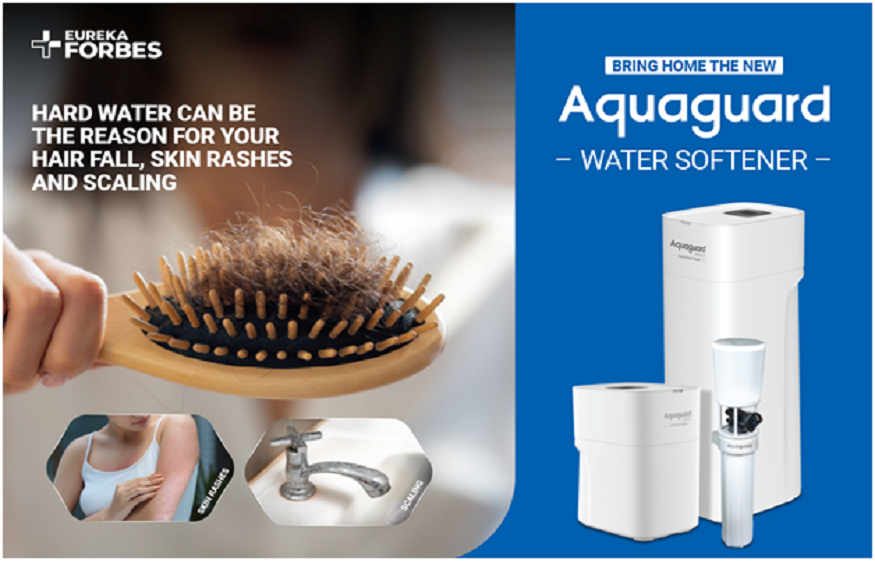
Softened water is safe for regular household use, and today’s hard water softeners are built to meet drinking water quality standards. Many top systems are also designed to use less salt and water than older models. The Aquaguard Select AWS C-1200 Water Softener by Eureka Forbes, for instance, is designed to cut salt consumption by around 30-40%. Its efficient control valves help optimise regeneration cycles, reducing overall water and salt usage.
Another option is the Aquaguard Select AWS I-2500 Water Softener, a fully automatic system suitable for independent homes. It uses ionic transfer technology to soften hard water and supports flow rates of up to 2,100 litres per hour. By addressing hardness at the source, it helps minimise common issues such as dry or itchy skin, hair fall, tile stains, and marks on bathroom fittings, making day-to-day water use more comfortable.
Final Thoughts
Hard water is a widespread issue that affects comfort, efficiency, and home infrastructure. Treating it with a properly selected water softener helps protect plumbing, extend appliance life, reduce energy costs, and improve everyday water use. Understanding the basics helps homeowners invest in a solution that delivers long-term value and peace of mind.